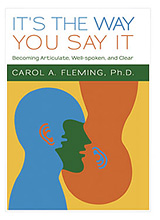
What Jay said about my book, “It’s the Way You Say It”
January 26, 2011 by Admin · Leave a Comment
Guest Blog Posting by Jay Conner, Richmond, California
I know Carol Fleming personally, and am vaguely familiar with her work. I’ve never been a client, but I knew she was in speech therapy.
Her book, however, is a revelation. What she does is so far beyond what you think of as speech therapy as to be a whole ‘nother world, She acts like a Minister of Communication, in the religious, not the governmental sense of the word.
In this book she shows you how to present yourself, to show yourself off to best advantage.
Consider how you detail a car, or how you stage a house to best show it off.
She teaches you how to do this with yourself.
I always thought that that if I had something to say, all I had to do was to get the message clear and the technique would take care of itself. And I wasn’t particularly critical about my natural, intuitive way of doing that presenting.
Dr. Fleming wants me to move that up a notch.
Her book is concise, direct and to the point, with lots of personal stories from her experience to make a lively reading experience. Tight, spare and engaging, with useful stories and clear instructions. You will also learn how a sentence with eleven consecutive instances of the word “had” can, in a proper context and properly punctuated, make a meaningful sentence. Page 63.
But that’s not important, it’s just diverting. Part of the funny side of the book.
The book has a more serious purpose, some real depth and the benefit of years of her experience in vocal development and communications training. Not everyone can trek out to San Francisco to engage her services, but everyone can benefit from her coaching in this book.
Even, especially, people who don’t know they need her help
In a sense, this book is a conversation with an author who has keen insight into the human condition, and a willingness - eagerness - to share her knowledge. Enthusiasm for the human condition runs through her stories, which are case histories of problems in human communication.