-

Dr. Carol Fleming
-
Quick tips for sounding Intelligent, Powerful, Polished, Articulate and Confident
January 12, 2011 by Admin · Leave a Comment

I know what you want. You want some quick tips to success. In these days of time pressure and job insecurity, who could blame you? So I will give you the ‘tips’ most frequently sought. At the same time, I will remind you that it takes more than a ‘tip’ to change your behavior. You might review what you already know about the word “practice” to use the following tips.
To Sound More Intelligent:
Speak just a bit slower than you normally do to give yourself time to select your most appropriate vocabulary and to give the impression of thoughtfulness.
To Sound More Powerful:
Use short, simple declarative sentences. You say what you mean and you mean what you say. Cut out any useless connectors, adjectives and adverbs, especially superlatives (Fantastic! Outstanding!, etc.).
To Sound More Polished:
Avoid answering a question with a blunt “yes” or “no”. Append a short phrase of clarification. For example, “No, I did not see it.” “Yes, I know Mary.” Doesn’t that sound more courteous?
To Sound More Articulate:
Make a special effort to pronounce the final sound in a word and use its energy to carry over to the following word. Readers of my book will recognize the principal of ‘linking’. Pay special attention to final “t”. (I can’t_ever count_on him.)
To Sound More Confident:
Carry your body in an upright posture. Hold your head as if you had a crown on it. Don’t let your arms and legs have side to side motion when you move. Keep your elbows and knees close to the midline of your body. Think “CEO” or “King” and you’ll probably get it right.
Pick just one of these tips to work on each day (or you’ll feel like the famous centipede who became paralyzed with too much thought). If you need more support or information in using these tips, you’ll find the information in my book, It’s the Way You Say It.
If you want to learn more about how Dr. Fleming can help you improve your communication skills, please call her at telephone 415.391.9179 or send her an email at [email protected]
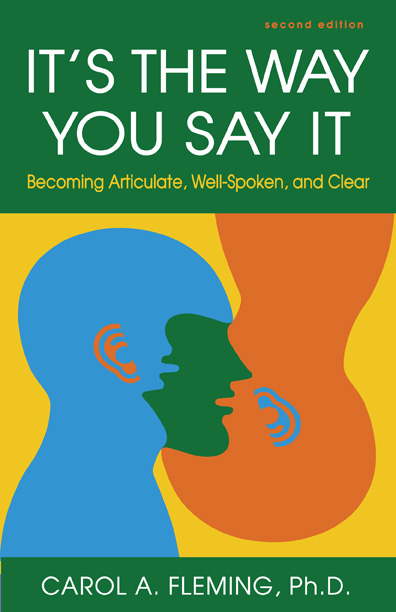
Carol Fleming, Ph.D., is the author of “It’s the Way You Say It”! Becoming Articulate, Well-spoken and Clear. A comprehensive guide to vocal development and improvement of communication skills. For people who want to make their speaking more impressive.
M9KRNEVBFEHA
Ten Commandments to Develop Finesse and Diplomacy at Meetings
June 3, 2010 by Admin · Leave a Comment
1. Turn off your phone and electronic devices so that you are fully present to the group. There is much to be learned through attentive listening and observation. You can arrange for hourly ‘recesses’ to attend to other pressing business.
2. Pause before you begin to speak. Collect your thoughts and discipline your tongue. Blurting and babble are way beneath your ability and status. Treat your own words as if they were valuable; gold coins, not theater pop-corn.
3. Anticipate probable objections and questions. To be caught by surprise or to be put on the defensive is uncomfortable and makes you lose your cool.
4. Start with the bottom line –the core message of your report – whenever you can. The more senior the audience, the more important it is to be mindful of their time and attention span. Don’t ever make them wait for you to get to the point. They may not.
5. Prepare a preliminary statement or story that demonstrates the background of your material so people understand the relevance of your information. Group members come from differing backgrounds and diverse interest and may need some help in getting properly oriented to understand your contribution.
6. Make an effort to be heard by the whole group. Speak out so that the person farther away can hear you. Since your voice goes where your eyes go, this means you should be making eye contact with these people.
7. Say, “I don’t know” when necessary and say what you will do to find out. Make no pretense to be a ‘know-it-all’. None of us do.
8. Be sensitive about any “Surprise Bombs” –unexpected news, good or bad – and give your superiors a heads-up. Their support will be valuable to you, and they really don’t want to be caught off guard?
9. Sit quietly and pay attention. Do not take assiduous notes or otherwise act like the secretary of the group. Be a fully invested participant. Don’t fiddle with your pencil, play with your pearls or look otherwise disengaged. Try to make some kind of contribution to the discussion.
10. Be respectful at all times. But watch out for ‘Nice” (too much smiling, nodding and deference). Your Leadership role is to assume authority and move the agenda. You will grow in finesse and diplomacy if you watch skilled group communicators deal with difficult situations and people (see #1 above).
If you want to learn more about how Dr. Fleming can help you improve your communication skills, please call her at telephone 415.391.9179 or send her an email at [email protected]
Carol Fleming, Ph.D., is the author of “It’s the Way You Say It”! Becoming Articulate, Well-spoken and Clear. Her book is a comprehensive guide to vocal development and improvement of communication skills, for people who want to learn how to speak better.
-
"It's The Way You Say It"
is the first comprehensive guide for speech and voice improvement. Click here to purchase Dr. Fleming's book from Amazon. Network With Me
