

Amazing Grace
December 19, 2011 by Admin · Leave a Comment
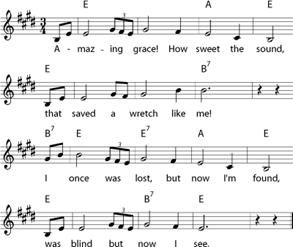
Twas Grace that taught my heart to hear…
I know! I know…now. I guess I wasn’t paying enough attention when the second verse of “Amazing Grace” rolled through my life. When I checked the lyrics of the song, before writing this, I found that out that Grace was to teach my heart to fear.
It didn’t work that way for me. Thank heavens.
While it is true that people come to me to learn about communication improvement, to get my opinion about something to do with their speech, voice or language, and to receive information and guidance, it is also true that they come to me to be heard; to have someone truly set aside all distractions, pre-judging, even focus, just to listen to the sound of their voice and receive them as wholly (perhaps holy) as possible.
What you say, how you say it and how you look when you say it. What is the first thing out of your mouth? What do you tell me repeatedly? At what point does anger creep into your voice? When does your voice wax and wane? How many bitter complaints come pouring out? Whose opinion really matters to you? When do your eyes glisten?
You have taught me to finally shut-up and let your presence register on me as deeply as possible. You have taught me that you cannot learn from me unless I have deeply listened to you first.
When you have run out of things to tell me, I will usually give you feedback on what I have just heard from you. If you are like most people, you will say, “You have hit the nail on the head!! How did you know!!” And I will have to answer, “Because you just told me.”
This is indeed an Amazing Grace that taught my heart to hear.
If you want to learn more about how Dr. Fleming can help you improve your communication skills, please call her at telephone 415.391.9179 or send her an email at [email protected]
Carol Fleming, Ph.D., is the author of “It’s the Way You Say It”! Becoming Articulate, Well-spoken and Clear. A comprehensive guide to vocal development and improvement of communication skills.
The Secret of a Good Speech
July 29, 2011 by Admin · Leave a Comment

I received this thank you note from a client:
Dear Carol, Lovely accolades after my speech and I did want to send you a thank you note! To be able to present my thoughts in a way that pleased me was a very happy moment. Not a word was shared about the how and why of it, but you and I know! Sending best thoughts and warmest thanks to you! xxx ————————————
Of course it is always nice to get thank you notes. But did you get the part that my work with her was going to be our little secret? Some clients call me their ‘secret weapon’ and tell me that they don’t want to share how they got so good with others. The business woman in me regrets this lack of acknowledgement and referral, of course. But the therapist side understands their need to own the effective speaking as their own talent and achievement.
Which leads me to ask how many skilled presentations, powerful speeches and touching comments you have heard and just assumed were the result of that speaker’s natural abilities and efforts? Just talented, right? · What if you found out that they floundered and stuttered at the beginning just like you do? That they had been paralyzed with stage fright? ·
What if you knew that many of these great speakers sought professional help, received thoughtful guidance, worked very hard, and rehearsed? You might ask these speakers if they had a ‘secret weapon” in preparing their remarks. Or if they might be able to recommend a speaking coach so you can learn to be as good as they were. Be interesting?
Please don’t let your fear of public speaking stop you. Get help like many others do. Dr. Fleming can be contacted at telephone number 415.391 9179 or [email protected]
How to improve your verbal communication
May 20, 2011 by Admin · Leave a Comment

When you want to improve any aspect of your speech there is one absolutely indispensable feature you must incorporate into your practice: other people. If you wanted to increase your vocabulary, of example, the stimulation of others will serve you better than time spent alone, agonizing over a list of words. As I wrote in my book (It’s the Way You Say It),
“When you spend time with different people of achievement and education, you will be exposed to words you don’t know; and you can learn these words just as a child learns them:
- by being exposed
- actively noticing and repeating them
- remembering the context of usage
- trying to use them.
As an adult you can ask speakers about the words they use that you don’t know. You probably think that people will look down on you for this, but not so. People will admire your desire to learn and your willingness to ask (and probably will be flattered to share their wisdom).”
Are you trying to improve your voice? Use store clerks and customer representatives in your initial practice. These are usually short and fairly anonymous contacts that should provide a safe place for you to practice actually usage.
Are you dealing with a foreign accent issue? Set a goal of one coffee break a day with people who speak only English. Many times the foreign born person seeks out the comfort of their fellow country men for social contacts, but this will only reinforce your original tongue.
Is public speaking the issue? By all means try to have another person in the room as you read or rehearse your remarks. Get used to people listening to you and, of course, they just might have some really valuable feed back for you.
Without the presence of other people verbal communication is artificial and hollow. Some privacy is needed at the initial stages of learning allowing you to focus deeply on mastering your behavioral change, but you don’t really start incorporating your learning until you are connecting with another human being. And isn’t that the point of it all?
Do You Need a Personal Communication Coach?
July 28, 2010 by Admin · Leave a Comment
Suppose there is something about the way you talk that really irritates people. How would you know? Without an objective, knowledgeable ear you will only know what you intend to say, not what is actually heard by others. Here are some of the problems you would run into:
1. It will seem to you that any problem in communication is always the fault of the other guys.
2. People will be reluctant to tell you, mostly because it would be both very rude and socially dangerous.
3. Very few people will know how to identify exactly what you are doing that is the problem. It does take expertise in verbal communication.
This is where a Personal Communication Coach would be immensely valuable to you. The relationship is confidential, professional and effective. The coach will support, instruct and sharpen the focus so that you gain maximum achievement for your effort. Yes, it cost money. But, yes, it works to put you in control of the sound of your voice.
“A Coach is someone who makes you do what you don’t want to do, has you see what you don’t want to see, so you can be everything you always wanted to be.” Tom Landry
You don’t know what you don’t know. Your personal coach helps you understand your blind side. I’m talking about the impression you make by the way you speak. Can you think of a better investment of your time and money?
Frodo: I wish the ring had never come to me. I wish none of this had happened.
Response: So do all who live to see such times, but that is not for them to decide. All you have to decide is what to do with the time that is given to you.
If you want to learn more about how Dr. Fleming can help you improve your communication skills, please call her at telephone 415.391.9179 or send her an email at [email protected]
Carol Fleming, Ph.D., is the author of “It’s the Way You Say It”: Becoming Articulate, Well-spoken and Clear. A comprehensive guide to vocal development and improvement of communication skills.
-
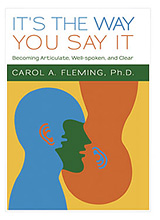
"It's The Way You Say It"
is the first comprehensive guide for speech and voice improvement. Click here to purchase Dr. Fleming's book from Amazon. Network With Me
