-

Dr. Carol Fleming
-
Playing the Game of Conversation
November 3, 2011 by Admin · Leave a Comment

Managing graceful small talk appears to be a difficult challenge for many of us. Do take comfort in knowing that there are things to know and do that will be of enormous help in dealing with small talk.
One such tip is the concept of ‘turn taking’ in conversation. First let’s look at how this can go wrong:
- One person starts talking and never gives up the floor; a long story, a monologue ensues, requiring no interaction. This feels really good to the speaker and really boring to the listener.
- One person smiles and nods and asks more questions of the other (like the person above) but never really makes a contribution to the conversation. They are cheer-leaders, not players.
Two sides of the same coin, wouldn’t you say?
The solution: think of any conversation as having a format like ping-pong or tennis. There is a back-and-forthing to make a game actually happen. You hog the ball, there is no action. And there is no fun if you let every shot go by without a return.
So:
- Always strive to pass the ball (topic) to the other person by asking a question
- Avoid long stories
- Understand that putting your two cents in is a conversational obligation
- Treat other people attempts to converse with respect and encouragement
Back and forth it must go; it is an ”inter-action”.
Speak up, - but not too much!
If you want to learn more about how Dr. Fleming can help you improve your communication skills, please call her at telephone 415.391.9179 or send her an email at [email protected]
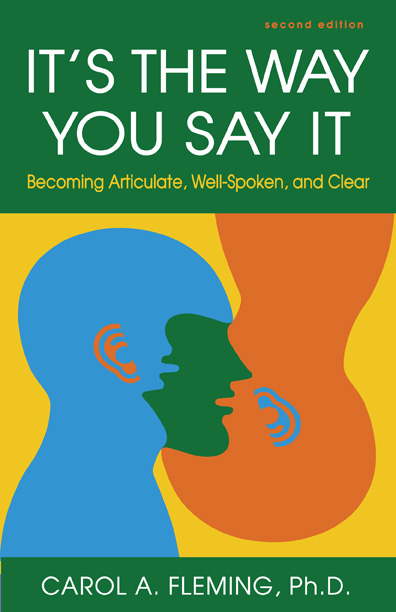
Carol Fleming, Ph.D., is the author of “It’s the Way You Say It”! Becoming Articulate, Well-spoken and Clear. A comprehensive guide to vocal development and improvement of communication skills.
Getting to Know the Sound of Your Voice
August 4, 2011 by Admin · Leave a Comment

The Sound of Your Voice
To listen to the blog posting in Audio, please click here —- Getting to Know The Sound of Your Voice
Do you want to know the impression you make by the way you speak?
I can help you do it in a way that won’t cost you a dime.
But, do I believe you will actually do this? No. So prove me wrong!
What to do:
Create a time for you and few (same sex) friends to get together around a good recording device, sit equidistant from the microphone, hit ‘record’….now talk to each other. Let’s say you chat about this or that for 20 minutes. Turn it off, rewind, take a lunch break, then sit down and listen.
What you might listen for:
- Who is doing the most talking?
- Who does the most interrupting?
- Who talks too softly to be heard?
- How low or high is your voice relative to the other people in the group?
- Can you understand yourself as easily as you do others?
- Do you like the sound of your laughter or are you embarrassed to hear that you sound like a Canadian goose?
- Do you hear something in your speech that you don’t like, like ‘like’?
- Does your voice sound flat as a board or should you consider opera?
And so on. Don’t worry; you’ll find much to notice. This may be a painful experience, OR you may well find much that you are pleased with.
I encourage your courage. This exercise allows you to know how you really interact with other people, more than I could possibly predict from a private interview. Consider how valuable this could be for you.
My offer: Do this exercise and write a short report on your communication behavior as you observed it on the recording. Send your report to me. (I can’t wait to read it!) I will write a blog about your findings. You can stay anonymous in the blog posting, should that be your choice. And I will send you a copy of my book, It’s the Way You Say It: Becoming Articulate, Well-spoken and Clear. Deal? I look forward to hearing from you.
It’s The Way You Say It

It’s the Way You Say It ….. but you knew that, didn’t you?
You’ve noticed that words are not the only players in our speaking. Talking turns out to be a pretty complex behavior. We are excellent analyzers of communication in other people, not so good for ourselves. Helping people understand and modify their impact has been a life’s work for me. Soon that work will be available to you in the form of a book called, you guessed it ….
It’s the Way You Say It - Becoming Articulate, Well-spoken and Clear
Easy to read and use, this book was written with the average person in mind and is based on the concerns they have about their speaking. Which is to say, the book is not an academic review. I do not attempt to be comprehensive, but I do attempt to be maximally useful. People care about the sound of their voice, their image as mature or confident, the adequacy of their vocabulary.
I bring unique knowledge and skills to the speaking needs of individuals and corporate clients. If you want to speak your mind effectively, I want to help you. I know what is important to the adult learner and how to streamline the learning process.
My book, It’s the Way You Say It; Becoming Articulate, Well-spoken and Clear is in production and will soon be available to you. Be sure you are signed up to receive notification. This book represents all that you, my clients, have taught me about the needs of people for communication effectiveness and comfort. This way I can help so many more people.
To learn more about my workshops, coaching and training products please visit my website or call me at (415) 391.9179
-
"It's The Way You Say It"
is the first comprehensive guide for speech and voice improvement. Click here to purchase Dr. Fleming's book from Amazon. Network With Me
