

The Ancient Technology of Talking - Story from my friend in Egypt
February 12, 2011 by Admin · Leave a Comment

I received an email from Egypt this Thursday from my old friend Essam; he got me thinking about the robust and timeless importance of face-to-face conversation. He reported:
“One of the biggest blunders committed so far by the Egyptian regime in its current crisis was the decision to shut down the Internet service and Mobile service all over the country on Thursday night before the ‘Friday of Anger’. By doing this, the smart decision makers thought they would isolate the demonstrators and prevent them from communicating with each other, thus reducing the number of people who would show up on Friday at the el-Tahrir square and elsewhere in the country. Based on this naïve assumption, the former minister of the interior, el-Adly, expected a maximum of two thousand demonstrators
When people were cut off from the rest of the world on Thursday night they started going out to the streets to find out what was going on, they started searching for their friends and relatives to inquire about their well being. They talked to each other face to face and agreed to be there all day on Friday. Suddenly tens of thousands showed up on Friday, instead of the two thousand the brutal el-Adly was prepared for.”
When someone pulls the plug on our electronic devices, we can always use the ancient technology of talking to each other. It is the part of the Basic Guarantee that comes with being human. (Even with the plug in, the Egyptian people have only a 40% literacy rate.) For this to truly be the Egyptian People’s revolution, they all must be able to speak out together.
In effect, he gave them their voice.
Carol Fleming, Ph.D., is the author of “It’s the Way You Say It”! Becoming Articulate, Well-spoken and Clear. A comprehensive guide to vocal development and improvement of communication skills. For people who want to make their speaking more impressive and find their voice. She can be contacted at telephone 415.391.9179 or send her an email at [email protected]
When Indirect Communication is the best Choice
September 27, 2010 by Admin · Leave a Comment
Suppose you wanted someone to know that you really appreciated the work they did. Shouldn’t you just go tell them? Well, that could be OK, I suppose, but it would really be gratifying to that person if you told Other People instead; people who are likely to get the message back to the individual.
Just imagine:
Joe is in the company cafeteria when a colleague says to him, “I heard your boss talking about your report this morning at the marketing meeting. He used your outline to show how the product roll-out would look. Way to go, fella!”
Of course, the boss could have just told you it was a good report, but I don’t think it would have had near the impact as knowing it had been bruited about the office.
- It wasn’t just a generalized ‘atta boy!’ of “feel-good” encouragement
- It wasn’t just a softly spoken private recognition between the two of you
It was out front, public declaration of your value. Just knowing that others heard it without it coming from you or being directed at you in front of others validates the integrity of the praise.
People are talking! Ain’t it sweet!?
Try it out yourself. Praise someone behind their back and see what happens. We are talking about backward gossip, aren’t we? I wish ‘pissog’ made a prettier word.
If you want to learn more about how Dr. Fleming can help you improve your communication skills, please call her at telephone 415.391.9179 or send her an email at [email protected]
Carol Fleming, Ph.D., is the author of “It’s the Way You Say It: Becoming Articulate, Well-spoken and Clear”. A comprehensive guide to vocal development and improvement of communication skills. To get your own copy, go to http://amzn.to/ItsTheWayYouSayIt
Speak! Four good reasons why you should give a speech
June 22, 2010 by Admin · Leave a Comment
- You find out what you are thinking/feeling when you have to find the words to express them. There are some people who really need to talk to discover what they are thinking. (Perhaps this is you; I know it is me). Sit in silence and your impressions are mush; vague, contradictory. Open your mouth and see what comes out!
- When you imagine your listeners, you must reconsider your words and sentences so that they are appropriate for the audience. What vocabulary level is best? Where should you begin? Your inner language becomes shaped for communication (to make common) with the listener in mind.
- Speak out and have a presence, be real, be a participant. If you think it doesn’t matter if you speak, what do you think others will think? They will likely not miss you. Find your 2 cents and put it in. What matters is that you have spoken up and made your presence felt. It reveals some self respect.
- You can make things happen, you can influence the course of events, you can prevent dreadful decisions from being made. Just by speaking out. Don’t be the bump on the log, be the speaker on the orange crate. People need leaders and spokesmen. Why not you? Speak!
……..
If you want to learn more about how Dr. Fleming can help you improve your communication skills, please call her at telephone 415.391.9179 or send her an email at [email protected]
Carol Fleming, Ph.D., is the author of “It’s the Way You Say It”! Becoming Articulate, Well-spoken and Clear. A comprehensive guide to vocal development and improvement of communication skills.
-
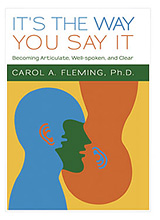
"It's The Way You Say It"
is the first comprehensive guide for speech and voice improvement. Click here to purchase Dr. Fleming's book from Amazon. Network With Me
