

Amazing Grace
December 19, 2011 by Admin · Leave a Comment

Twas Grace that taught my heart to hear…
I know! I know…now. I guess I wasn’t paying enough attention when the second verse of “Amazing Grace” rolled through my life. When I checked the lyrics of the song, before writing this, I found that out that Grace was to teach my heart to fear.
It didn’t work that way for me. Thank heavens.
While it is true that people come to me to learn about communication improvement, to get my opinion about something to do with their speech, voice or language, and to receive information and guidance, it is also true that they come to me to be heard; to have someone truly set aside all distractions, pre-judging, even focus, just to listen to the sound of their voice and receive them as wholly (perhaps holy) as possible.
What you say, how you say it and how you look when you say it. What is the first thing out of your mouth? What do you tell me repeatedly? At what point does anger creep into your voice? When does your voice wax and wane? How many bitter complaints come pouring out? Whose opinion really matters to you? When do your eyes glisten?
You have taught me to finally shut-up and let your presence register on me as deeply as possible. You have taught me that you cannot learn from me unless I have deeply listened to you first.
When you have run out of things to tell me, I will usually give you feedback on what I have just heard from you. If you are like most people, you will say, “You have hit the nail on the head!! How did you know!!” And I will have to answer, “Because you just told me.”
This is indeed an Amazing Grace that taught my heart to hear.
If you want to learn more about how Dr. Fleming can help you improve your communication skills, please call her at telephone 415.391.9179 or send her an email at [email protected]
Carol Fleming, Ph.D., is the author of “It’s the Way You Say It”! Becoming Articulate, Well-spoken and Clear. A comprehensive guide to vocal development and improvement of communication skills.
The Artists
December 15, 2011 by Admin · Leave a Comment
You’ve all heard of the importance of nonverbal communication. But have you ever wondered if it is all that it’s cracked up to be? Let me give you the evidence shown in the new film, The Artist.
- It is a ‘silent movie’ that allows you to experience how much meaning - both broad and subltle -there is to be had without words.
- Oh sure, from time to time, they throw a pinch of dialogue on the screen, but the meat of the movie is in the expressions, the context, the attitudes and movements that need no language to tell us what is going on.
- The music also moves the agenda in a nonverbal way.
Have you noticed that digital devices are fed streams – gushing rivers – of alphabetized code letters? Have we not come to see this alphabetic tidal wave as the alpha and omega of human communication?
But, have you also noticed that those who gorge themselves at the digital trough are frequently unskilled in the human nonverbal world of animal presence and subtle expression? This nonverbal world is the home of all human relationships worth having. This is the world where you are most fully alive and authentic. This is the world where you can fall in love.
See the picture and see how much of life you can know without a word being spoken.
If you want to learn more about how Dr. Fleming can help you improve your communication skills, please call her at telephone 415.391.9179 or send her an email a t[email protected]
Carol Fleming, Ph.D., is the author of “It’s the Way You Say It”! Becoming Articulate, Well-spoken and Clear. A comprehensive guide to vocal development and improvement of communication skills.
How Professionalism is impacting your job search!
March 30, 2011 by Admin · Leave a Comment
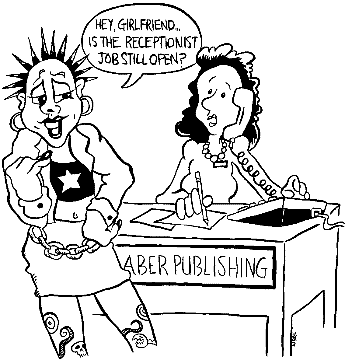
We need to understand what professionalism means. It is as simple as one-two-three.
Professionalism
As a consumer yourself, wouldn’t you lose confidence:
- If the office of your financial advisor was piled with dog-eared, personal stuff?
- If an attorney had slurred speech or a flat voice?
- If a restaurant waiter appeared poorly groomed?
These are all breeches in personal professionalism and the individual will instantly lose credibility because the behavior is incongruent with their professional pretension.
And as an employer: If someone showed up for a job interview gnawing on some chewing gum, or showing no knowledge of your company, and speaking like a teen-ager.
Being professional means that you have paid attention to developing your:
1. Expertise
What you get money for. The stuff you know when you know your stuff. An expert is someone widely recognized as a reliable source of technique or skill. In addition, your personal behavior and character must support your claim to expertise.
2. Credibility
Communication Skills play a more detailed role in determining your credibility. It doesn’t matter if you have the expertise and character for your occupation if you are unable to communicate this to other people. How do you communicate your expertise? Understanding that what you say, how you say it and how you look when you say it – must all carry the same message. The professional considers all aspects of their communication connection to others for ways to improve:
(a) The Content: What you say includes your grammar and general language facility. The appropriateness of your comments and the language of courtesy is received and evaluated beyond your intent.
(b) The Tonalities: How you say something makes all the difference in the meaning received. A flat intonation of an otherwise straightforward statement can suck all the life and energy out, leaving a dreary flow of lifeless words.
(c) How you Look when you talk is the third and vital part of your speaking. It is a category that is actually quite wide and varied, from the care you took in combing your hair, to the wild flow of expressions on your face to the quality of the fabric of your suit. People are constantly looking you over for meaning and finding it.
It is of utmost important that these three components of communication support your professionalism, that they are congruent. Congruency determines if you are perceived as authentic which gives you credibility.
One issue is central: congruency
Two areas must be congruent: your professionalism and your communication impact.
Three aspects of communication must carry the same message. See above.
To learn how Dr. Fleming can help you to “Speak your Best” and improve your professionalism for job interviews, contact her at telephone number (415) 391.9179 or email [email protected]
Three steps to conquering the “up-ending sentence”
December 10, 2010 by Admin · 2 Comments

You’ve heard about the pernicious ‘up-ending sentence’. Which is exactly that; a sentence that ends with an upward rising pitch line, much like that of the questioning intonation you might used when you say, “Is that for me?” , “Is he OK?”. Obviously, this is a perfectly OK kind of thing to do. But when this questioning tone is heard with other sentence forms, and too many times, it creates a sound of childlike insecurity. It sounds as if you are asking for permission or affirmation.
Let’s do something about it!
Step 1: You’d better find out if This Means You. You might listen to your outgoing message on your voice mail and see if you hear something like, “This is Marcia Jones? I’ll be out of the office today? You can leave a message after the beep? Have a nice day!” If you are smart you will listen to yourself on a recording or ask trusted friends.
Step 2: Deal with the emotional element. You need to have the attitude of telling someone something in an authoritative manner. This is in contrast to a tone of voice that asks for affirmation of your message. Prepare a paragraph of information in the form of simple declarative sentences (subject/predicate). Now read it in a way that conveys you expect to be understood and obeyed. (Not asking for permission, not asking for affirmation with a head nod, etc.)
For example:
“I have asked every one in the department to be at this meeting. I expect that you have all signed the attendance sheet. You will need to pay attention to the new regulations we have received. You will be expected to relay them to your own staff. Please examine the documents on the table in front of you.” Etc.
Deliver these lines with an authoritative attitude; you should be bringing your pitch down at the end of each short sentence to show you mean it.
Step 3: Everyday you should intentionally use the simple declarative sentence form with a lower pitch level at the end. Make up 10 sentences just by looking around the room. Be stupid and obvious, not deep or clever. (The rug is brown. The telephone is blinking. I can look outside. I can hear my neighbors’ voice. There is plant on my desk., etc.)
This is working on the ‘habit’ part of your speaking. Do this simple task every day (with careful self-monitoring) to make the pattern consistently authoritative and comfortable in your mouth. Do this several times a day for a week and see how easy it comes to you when you need it!
………..
If you would like Dr. Fleming’s help to identifying your communication problem areas and helping you get started on your own improvement, consider getting her Holiday Speak Your Best! Package, which offers a copy of her book, CD or Audio Series and a Consultation. To learn more about the Speak Your Best! package go to www.speechtraining.com/holidayspecial/
How to Help Employees Speak Their Best
December 2, 2010 by Admin · Leave a Comment



Here’s a difficult situation for you employers:
You have a perfectly good employee, adequate, even good in most ways, BUT, there’s something about the way they talk that is a problem: for you, for them, and for your customers.
What do you do? What should you do?
The first issue would be your ability and willingness to offer them some help.
Let’s say you are in a position to offer some speech therapy, voice coaching or communication consulting to them. You would consider this because of the investment you have already made in their training and because you sense that they would really benefit from this instruction.
The second issue has to do with how you broach the topic.
You are embarrassed because you think you are going to embarrass them, right? How do you tell someone that their speech is not good enough?
Here’s one way:
“ Pat, you are particularly good at managing your work flow and keeping reliable records. You show a good grasp of the marketing issues we have to consider. We’d like to see if we can’t bring up some of your communication skills to the same level of excellence as your other abilities. We think you would be good with more actual sales exposure. We’d like to invest in your professional development by supporting a two month program of Communication Development training.”
There. How does that feel?
I’d love to hear your reaction to this approach. Let me know if it has solved a problem for you.
…..
If you would like to help someone (family, friend or employee) work on their speaking skills, you might consider the gift of Dr. Fleming’s Holiday package: Speak Your Best!
Click here to learn more about Dr. Carol Fleming’s Gift Package, Speak Your Best!
How can a book improve your communication?
November 9, 2010 by Admin · Leave a Comment

How can a book improve your communication? There are two ways, you can read it or you can put it on your head.
Explanation:
Actually there is only one book to read that will really be helpful for the wide array of communication needs of the modern world and that book is the one I wrote; It’s the Way You Say It: Becoming Articulate, Well-spoken and Clear. See below.
The book you put on your head needs to be hard cover – (Mine comes in hard cover!) - so it can balance on your head. Now, why on earth would you want to do such a thing?
Because it will act as a feed back mechanism about the way you hold your body, your posture. Your carriage will have a marked influence in how you are perceived.
- You cannot be dignified if your head is bobbing up and down, nodding or tilting.
- You cannot look mature if you tend to cock your head to one side.
- You cannot look ‘together’ if you bounce along as you walk or allow your shoulders to slouch forward and pull your head out of alignment.
Everybody admires strong, upright posture.
This is where the book comes in as an excellent source of information.
1. As you look in the full length mirror, hold yourself in an up-right (but natural) posture and place the book flat on the top of your head.
2. Try turning your head from side to side, keeping your chin line straight. Take some steps forward and back and from side to side, keeping that book in place.
3. Walk around the room, keeping that book in place on your head.
4. Now add the speech component; start talking and notice how much you want to move your head.
5. Sit on front of a mirror and call someone on the phone. Place the book on your head and start talking. You will probably lose the book a couple of times.
6. At all times, pay attention to the alignment of your head and body as you use the book, so you can learn how to hold your head and body upright without the book.
7. Give yourself daily practice with this routine for a week and you should be able to ‘straighten up’ with only conscious effort (and no book).
Announcement: Dr. Fleming’s book can now be purchased at Alexander Book Co and Book Passage in both Corte Madera and San Francisco!
If you want to learn more about how Dr. Fleming can help you improve your communication skills, please call her at telephone 415.391.9179 or send her an email at [email protected]
Carol Fleming, Ph.D., is the author of “It’s the Way You Say It”! Becoming Articulate, Well-spoken and Clear. A comprehensive guide to vocal development and improvement of communication skills. . To get your own copy, go to http://amzn.to/ItsTheWayYouSayIt
Preparing for Your Presentation
November 1, 2010 by Admin · Leave a Comment
Have you heard the rumor that thorough preparation is the most effective thing you can do to avoid stage fright? It’s true. And I want to talk about one little bitty part of the preparation process, the out loud rehearsal of your material before your delivery.
No, not silent reading to yourself, I want you to wrap your tongue around your words so they fit comfortably in your mouth. If there are some tricky phrases or difficult words, isn’t it better to find this out BEFORE you are in front of your audience? And, once discovered, you can fix them, can’t you? Of course you can.
Now you are ready to put some large photos of people on the other side of the room, and say your speech out loud to the pictures, moving your eyes from one face to another as you present a thought or a phrase. Let yourself get used to making eye contact AND talking at the same time. You probably do this quite naturally when you are not giving a speech – we’re just bringing unconscious communication behavior up to the conscious level so you won’t forget to do it.
People earnestly ask me if they shouldn’t talk to themselves in front of a mirror. And I say, no they shouldn’t. Such a silly idea. I won’t even go into all the reasons that the idea has me shaking my head….sadly. But I do have a better idea. Add a real human being in the room with your pictures, one who will make you feel just a bit of self-consciousness.
Why? Because you want to get used to performing in the same state of excitation as will happen when you actually talk. You are going to toughen up with a little dose of the nerves so it doesn’t get you by surprise when you really speak.
Use the mirror to straighten your tie or check your lipstick. Use your neighbor to practice your speech.
If you want to learn more about how Dr. Fleming can help you improve your communication skills, please call her at telephone 415.391.9179 or send her an email at [email protected]
Carol Fleming, Ph.D., is the author of “It’s the Way You Say It”! Becoming Articulate, Well-spoken and Clear. A comprehensive guide to vocal development and improvement of communication skills. . To get your own copy, go to http://amzn.to/ItsTheWayYouSayIt
A Defense Against Stage Fright

You have to give a speech and you are already getting anxious. You are given the follow advice from some helpful person:
“Just picture your audience in their underwear.”
This is supposed to allay your personal intimidation by making your audience more psychologically vulnerable. They are in their undies and you have your pants on.
So, let’s give it a try. Take a good look at the picture above and see how safe and comfortable it makes you feel. And now imagine how real people would look in their underwear. (That should really scare you!)
Don’t you just want to say, “Oh for heaven’s sake, go put some clothes on!”
Can I suggest another approach? Think of your audience as people who have come to your party. They are your guests. You want them to be comfortable, to get something of value, and to have their need for information met. In other words, you should adopt a service attitude; “How can I help these people?”, “What do they need to know?” “How can I serve them?”
Focusing on their needs with a service attitude will take you out of the stage fright mode. Remember, public speaking is not about you. It’s about your audience. So give them the shirt off your back. It will make you feel a lot better.
If you want to learn more about how Dr. Fleming can help you improve your communication skills, or help you to overcome stage fright, please call her at telephone 415.391.9179 or send her an email at [email protected]
Carol Fleming, Ph.D., is the author of “It’s the Way You Say It”! Becoming Articulate, Well-spoken and Clear. A comprehensive guide to vocal development and improvement of communication skills. . To get your own copy, go to http://amzn.to/ItsTheWayYouSayIt
-
"It's The Way You Say It"
is the first comprehensive guide for speech and voice improvement. Click here to purchase Dr. Fleming's book from Amazon. Network With Me
