Projecting Self-Confidence in Job Interviews
July 9, 2010 by Admin · Leave a Comment
You have credentials, you have experience, you have references, BUT you don’t speak with authority and assurance. You hold your voice in the back of your throat. Your face shows little movement and expressiveness when you talk. You may be aware of some tension in your throat. It’s as if you are holding your cards close to your chest, fearful that someone will see what you’ve got.
Self confidence is immediately perceived to the extent that you energize your articulation and let your speaking be clearly visible on your face. Now is not the time to mumble! By placing your speaking energy in the front of your face, you are illustrating your confidence in your talents, achievements and reputation.
Does this apply to you? You start your improvement by trying to honestly answer this question. You must go outside of yourself to get the answer. (We always think we are speaking clearly!) Here are two ways of finding out if this is your problem.
1. Do people frequently ask you to repeat yourself? If so, they are telling you that they are not getting enough information through their ears or their eyes to be confident that they have gotten your message.
While it is true that communication can be hindered by noise in the environment, a hearing loss in your companion, etc., the energy that you invest in your articulation can overcome those obstacles.
2. Observe yourself in a videoed conversation. Watch your facial movement. Compare it to the way other people speak. You might think of some television newscasters or hosts. Take your time and give yourself a chance – don’t just glance and try to make a judgment.
It is also true that a restricted speaking style might just appear when you are self-conscious during an interview. You can try to recreate those circumstances. When I see a client for the first time and video our interview, we pretty much create the ‘under-the-magnifying-glass’ experience intentionally so I can see what you actually do when you are uncertain. (If we cannot observe the behavior we cannot change it.)
You want to let your commitment show on your face to lend credibility to what you say. Do the best you can to make a thoughtful appraisal of your speaking behavior.
……………………………..
If you want to learn more about how Dr. Fleming can help you improve your communication skills, please call her at telephone 415.391.9179 or send her an email at [email protected]
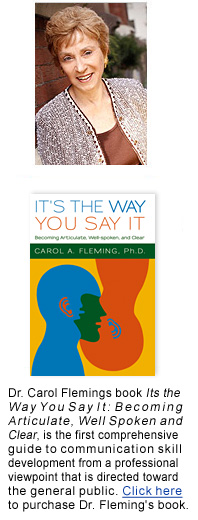
Carol Fleming, Ph.D., is the author of “It’s the Way You Say It”! Becoming Articulate, Well-spoken and Clear. A comprehensive guide to vocal development and improvement of communication skills.
