
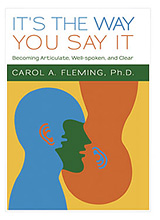
Dr. Carol Fleming's book "It's The Way You Say It" is the first comprehensive guide for speech and voice improvement. As you communicate with people, they come to know you both as an individual and a professional person. The only way people can sense your intelligence and professionalism is through the effectiveness of your communication: what they hear you say, the attitude that is perceived, and the very sound of your voice. What Jay Conner, California is saying about "It's The Way You Say It" Dr. Fleming’s book is a revelation. What she does is so far beyond what you think of as speech therapy as to be a whole ‘nother world. She acts like a Minister of Communication, in the religious, not the governmental sense of the word. In this book she shows you how to present yourself, to show yourself off to best advantage. Her book is concise, direct and to the point, with lots of personal stories from her experience to make a lively reading experience. Tight, spare and engaging, with useful stories and clear instructions. For more information about Dr. Fleming's products or services, contact her at telephone number 415.391.9179 or [email protected]


The Ancient Technology of Talking - Story from my friend in Egypt

February 12th, 2011

When someone pulls the plug on our electronic devices, we can always use the ancient technology of talking to each other. It is the part of the Basic Guarantee that comes with being human. (Even with the plug in, the Egyptian people have only a 40% literacy rate.) For this to truly be the Egyptian People’s revolution, they all must be able to speak out together.

In effect, he gave them their voice.
What Jay said about my book, “It’s the Way You Say It”

January 26th, 2011

Her book, however, is a revelation. What she does is so far beyond what you think of as speech therapy as to be a whole ‘nother world, She acts like a Minister of Communication, in the religious, not the governmental sense of the word.

In this book she shows you how to present yourself, to show yourself off to best advantage.
Consider how you detail a car, or how you stage a house to best show it off.
She teaches you how to do this with yourself.

Quick tips for sounding Intelligent, Powerful, Polished, Articulate and Confident

January 12th, 2011

I know what you want. You want some quick tips to success. In these days of time pressure and job insecurity, who could blame you? So I will give you the ‘tips’ most frequently sought. At the same time, I will remind you that it takes more than a ‘tip’ to change your behavior. You might review what you already know about the word “practice” to use the following tips.

The King’s Speech….and yours

January 3rd, 2011

Many, many people have concerns about the way they speak. People you know, like your buddy, your boss or the guy that fixes your appliances. If you hear something that draws attention to the way they talk you can be pretty sure that they will probably have some sensitive feelings about it. We want people to respond to what we say, not get distracted by how we say it.

Three steps to conquering the “up-ending sentence”

December 10th, 2010

You’ve heard about the pernicious ‘up-ending sentence’. Which is exactly that; a sentence that ends with an upward rising pitch line, much like that of the questioning intonation you might used when you say, “Is that for me?” , “Is he OK?”. Obviously, this is a perfectly OK kind of thing to do. But when this questioning tone is heard with other sentence forms, and too many times, it creates a sound of childlike insecurity. It sounds as if you are asking for permission or affirmation.

How to chat off-line (i.e. small talk)

December 7th, 2010

The importance of small talk

Small talk is frequently undervalued and dismissed with the result that you never get good at it. I am urging an attitude adjustment here and I am telling you that it is possible to get really good at this.

Start by making it a priority to find a way to be interested and appreciative of other people FIRST before you try to sell your pots and pans. There are far more pots and pans out there than there are people you know and like and trust.

How to move from small talk to the elevator pitch

How to Help Employees Speak Their Best

December 2nd, 2010

Here’s a difficult situation for you employers:

You have a perfectly good employee, adequate, even good in most ways, BUT, there’s something about the way they talk that is a problem: for you, for them, and for your customers.

What do you do? What should you do?

The first issue would be your ability and willingness to offer them some help.

Two Secrets about speech and voice revealed, and a solution suggested

November 23rd, 2010

Secret #1: Many people are secretly embarrassed about the sound of their voice, for example:

* they are afraid the pitch of their voice is too high,
* that they mumble,
* that they have forgotten a lot of their vocabulary, or
* or that they sound like dimwits when they speak in public

Secret #2: People do not realize that they really can change the way they talk.

How can a book improve your communication?

November 9th, 2010

How can a book improve your communication? There are two ways, you can read it or you can put it on your head.

Explanation:
Actually there is only one book to read that will really be helpful for the wide array of communication needs of the modern world and that book is the one I wrote; It’s the Way You Say It: Becoming Articulate, Well-spoken and Clear. See below.

The book you put on your head needs to be hard cover – (Mine comes in hard cover!) – so it can balance on your head. Now, why on earth would you want to do such a thing?

Because it will act as a feed back mechanism about the way you hold your body, your posture. Your carriage will have a marked influence in how you are perceived

Preparing for Your Presentation

November 1st, 2010

Have you heard the rumor that thorough preparation is the most effective thing you can do to avoid stage fright? It’s true. And I want to talk about one little bitty part of the preparation process, the out loud rehearsal of your material before your delivery.

No, not silent reading to yourself, I want you to wrap your tongue around your words so they fit comfortably in your mouth. If there are some tricky phrases or difficult words, isn’t it better to find this out BEFORE you are in front of your audience? And, once discovered, you can fix them, can’t you? Of course you can.