

Two Secrets about speech and voice revealed, and a solution suggested
November 23, 2010 by Admin · Leave a Comment

See that successful looking man over there? He’s very confident isn’t he?
In my office with the doors closed, this same man confesses that he has always been embarrassed about the way he sometimes repeats words or sounds. That’s why he avoids public speaking at all costs (and it does cost him in opportunity).
How about that gorgeous young woman over there? Surely she’s got it all.
She records her outgoing voicemail messages over and over, because she is so ashamed of her ‘valley girl’ sound. Let’s see, just how much time does she waste doing this?….
Secret #1: Many people are secretly embarrassed about the sound of their voice, for example:
- they are afraid the pitch of their voice is too high,
- that they mumble,
- that they have forgotten a lot of their vocabulary, or
- or that they sound like dimwits when they speak in public
Secret #2: People do not realize that they really can change the way they talk.
You CAN change:
- Voice pitch
- Vocal quality
- Use of mannerisms
- Skill in public speaking
- Comfort in social conversation
- The clarity of your articulation
And much, much more
The Solution: I am offering a Holiday Special: Speak Your Best that helps people get started changing the way they talk. It can change a future, it can change a life. Treat yourself to this offer, or give someone you love the opportunity to develop their own speaking skills – and it’s a great start to your New Year’s Resolution to do something about The Way You Speak.
My offer includes:
1. A copy of my new book: It’s the Way You Say It: Becoming Articulate, Well-Spoken and Clear
2. My classic and best-selling CD, The Sound of Your Voice, and
3. A 20 minute phone or Skype consultation. After hearing your speaking concerns and questions, Dr. Fleming will guide you to the materials in the book and audio series that will have the most importance in your development. This will help you save time, set realistic goals, and be focused.
For more details about the offer, please visit www.speechtraining.com/holidayspecial
Please feel free to contact me with any questions at:
[email protected]
Or Telephone 415.391-9179
I would love to hear from you.
Happy Holidays
Carol Fleming
How can a book improve your communication?
November 9, 2010 by Admin · Leave a Comment

How can a book improve your communication? There are two ways, you can read it or you can put it on your head.
Explanation:
Actually there is only one book to read that will really be helpful for the wide array of communication needs of the modern world and that book is the one I wrote; It’s the Way You Say It: Becoming Articulate, Well-spoken and Clear. See below.
The book you put on your head needs to be hard cover – (Mine comes in hard cover!) - so it can balance on your head. Now, why on earth would you want to do such a thing?
Because it will act as a feed back mechanism about the way you hold your body, your posture. Your carriage will have a marked influence in how you are perceived.
- You cannot be dignified if your head is bobbing up and down, nodding or tilting.
- You cannot look mature if you tend to cock your head to one side.
- You cannot look ‘together’ if you bounce along as you walk or allow your shoulders to slouch forward and pull your head out of alignment.
Everybody admires strong, upright posture.
This is where the book comes in as an excellent source of information.
1. As you look in the full length mirror, hold yourself in an up-right (but natural) posture and place the book flat on the top of your head.
2. Try turning your head from side to side, keeping your chin line straight. Take some steps forward and back and from side to side, keeping that book in place.
3. Walk around the room, keeping that book in place on your head.
4. Now add the speech component; start talking and notice how much you want to move your head.
5. Sit on front of a mirror and call someone on the phone. Place the book on your head and start talking. You will probably lose the book a couple of times.
6. At all times, pay attention to the alignment of your head and body as you use the book, so you can learn how to hold your head and body upright without the book.
7. Give yourself daily practice with this routine for a week and you should be able to ‘straighten up’ with only conscious effort (and no book).
Announcement: Dr. Fleming’s book can now be purchased at Alexander Book Co and Book Passage in both Corte Madera and San Francisco!
If you want to learn more about how Dr. Fleming can help you improve your communication skills, please call her at telephone 415.391.9179 or send her an email at [email protected]
Carol Fleming, Ph.D., is the author of “It’s the Way You Say It”! Becoming Articulate, Well-spoken and Clear. A comprehensive guide to vocal development and improvement of communication skills. . To get your own copy, go to http://amzn.to/ItsTheWayYouSayIt
How to Improve the Sound of Your Voice
June 30, 2010 by Admin · Leave a Comment
The sound of your voice is the most intimate part of your communication and the public part of your self. One would think that you would want to listen to your self with the same attention and thoughtfulness that you would examine a photograph of yourself for your website or for your office wall. But no.
There are several reasons why you would be reluctant.
- We did not evolve hearing our own voice as others hear it. (We DID evolve with the ability to see ourselves on reflective surfaces like water.) It is psychological shocking to hear the voice as it is ‘out there’ and not as it sounds in our head during the act of speaking.
- We are highly skilled at reading the voices of others. We make judgments based on this information. We feel exquisitely vulnerable when our own voice falls within this sensitive analytic radar.
- We know how to smile and comb our hair and otherwise manage our visual impact. We do NOT know how much we can improve our vocal image.
A first step is to become specific about your voice goal by listening to yourself objectively, using a good voice recording (NOT a answering machine message!).
Listen for issues of:
- Pitch- Your customary pitch level, how high or low your voice is. Pitch is a major clue for maturity and gender identity.
- Volume - How soft or loud. You must make sure that people can hear you comfortably or you irritate them or waste their time.
- Quality - The tonal quality of your voice; raspy, breathy, thin, rich, melodious, resonant. You can sound healthy/attractive. Or not.
- Tension - Evidence of excessive tension through stridency and staccato syllables and the sound of effort.
The moral of this story:
1. You can improve the sound of your voice. You don’t have to be stuck the way you are.
2. Start with focused listening to determine what aspect you would like to change. You have made your first step.
If you want to learn more about how Dr. Fleming can help you improve your communication skills, please call her at telephone 415.391.9179 or send her an email at [email protected]
Carol Fleming, Ph.D., is the author of “It’s the Way You Say It”! Becoming Articulate, Well-spoken and Clear. A comprehensive guide to vocal development and improvement of communication skills.
How to make the most of your voice
June 9, 2010 by Admin · Leave a Comment
Your voice is the carrier of more than information. It is your personality, your health and identity, your song. Like your breathing, it is so important to your life that you can practically forget about it and get away with it. Your body is quite expert in dealing with both breath and voice.
But, you could do more with your voice if you wanted to.
1. You could protect your voice from injury. Especially if you are a person who uses their voice for a living, like a teacher or a salesperson, and you want to take voice care seriously. But any person who values their voice must pay attention to these rules:
- Do not smoke. Period
- Notice persistent fatigue, soreness or hoarseness and take it to a physician (ENT). Don’t be stupid: don’t wait.
- Vocal abuse is real and can hurt you. Watch out for yelling, talking loudly for long periods and prolonged throat tension.
2. You should become mindful of the voice in all spoken communication. Become aware of the contribution of tonal support, melody and appropriate volume (loudness) to all spoken language and notice how much this tonal element contributes to the meaningfulness of language. Some people reduce the amount of change and variety in their voice to reduce expression of their emotion. This is usually a poor exchange. We need the music of the human voice to truly understand each other.
3. You would develop your voice as an art form. Certainly singing is at the top of that list, but don’t overlook oral reading, poetry and drama. Your voice is an instrument that you can learn to develop, master and enjoy for the rest of your life. There are teachers and opportunities around you. Look for them. You live in a sonorous universe. Add your voice to the chorus.
If you want to learn more about how Dr. Fleming can help you improve your communication skills, please call her at telephone 415.391.9179 or send her an email at [email protected].
Carol Fleming, Ph.D., is the author of “It’s the Way You Say It”! Becoming Articulate, Well-spoken and Clear. A comprehensive guide to vocal development and improvement of communication skills. For people who want to make their speaking more impressive.
Breathing RIGHT
May 17, 2010 by Admin · Leave a Comment
Let’s say you are trying to improve your voice and someone tells you to “Take a nice deep breath of air”. Do you vigorously elevate your shoulders and audibly inhale? If the answer is ‘yes”, then you are breathing WRONG.
You have just ACTED OUT, “I am breathing” with visual and sound effects, throwing way too much tension and effort into what should be the most natural and easy of activities. And you have been taught this wrong way by a number of instrument teachers, exercise coaches and yoga instructors.
Get in touch with natural breathing
Your first step is to stop unnecessary tension and get back to what comes naturally to the human body. Just follow these steps:
- Stand in front of a mirror so you can check your shoulder and mid-section movements.
- Allow your arms to hang naturally and your shoulders to be completely relaxed; they are NOT going to be involved in this exercise.
- When you inhale (take air in), imagine that you are breathing through your belly button, with the movement of expansion only at your belt line (mid-section).
- Because you are relaxing your air passages, There Are No Sound Effects. Use your mouth or your nasal passages, I don’t care. Just keep it silent.
- Don’t make yourself breathe: Let yourself breathe. Think of allowing the midsection of your trunk to expand; there should be NO effort involved, no on-purpose contraction of muscle. There is a large muscle inside your body called the diaphragm that is doing the work of enlarging the chest by moving downward. You’ve heard of ‘breathing from the diaphragm”? That’s what we’re talking about.
See the lady on her back at the top of the page? She is feeling the movement of her belly consequent to diaphragmatic action. If you are unsure about this issue, I recommend you get on the floor right now and put your hand on your belly to just feel the relaxed breathing movement. Pant like a dog to feel it exaggerated.
Is there time when that heaving of the upper chest and shoulders is appropriate? (Remember the scolding in the first paragraph?) Yes, in emergency conditions such as:
- Getting ready to swim the length of the pool underwater
- Running from a mugger
- Preparing to sing high C for 6 measures
Now, tell yourself to take a nice, deep breath and watch what you do. Remind yourself to relax the shoulders and let the diaphragm do the work.
If you want to learn more about how Dr. Fleming can help you improve your communication skills, please call her at telephone 415.391.9179 or send her an email at [email protected]
Carol Fleming, Ph.D., is the author of “It’s the Way You Say It”! Becoming Articulate, Well-spoken and Clear. A comprehensive guide to vocal development and improvement of communication skills. For people who want to make their speaking more impressive.
*Belly breathing illustration. Copyright 2004 by Dennis Lewis. Reprinted from Free Your Breath, Free Your Life, by Dennis Lewis (Shambhala, 2004) with the permission of the author. You can learn more about him and read his essays on his blog at http://www.dennislewisblog.com. His website is http://www.dennislewis.org
-
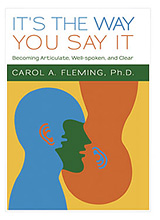
"It's The Way You Say It"
is the first comprehensive guide for speech and voice improvement. Click here to purchase Dr. Fleming's book from Amazon. Network With Me
