I received an email from Egypt this Thursday from my old friend Essam; he got me thinking about the robust and timeless importance of face-to-face conversation. He reported:
“One of the biggest blunders committed so far by the Egyptian regime in its current crisis was the decision to shut down the Internet service and Mobile service all over the country on Thursday night before the ‘Friday of Anger’. By doing this, the smart decision makers thought they would isolate the demonstrators and prevent them from communicating with each other, thus reducing the number of people who would show up on Friday at the el-Tahrir square and elsewhere in the country. Based on this naïve assumption, the former minister of the interior, el-Adly, expected a maximum of two thousand demonstrators
When people were cut off from the rest of the world on Thursday night they started going out to the streets to find out what was going on, they started searching for their friends and relatives to inquire about their well being. They talked to each other face to face and agreed to be there all day on Friday. Suddenly tens of thousands showed up on Friday, instead of the two thousand the brutal el-Adly was prepared for.”
When someone pulls the plug on our electronic devices, we can always use the ancient technology of talking to each other. It is the part of the Basic Guarantee that comes with being human. (Even with the plug in, the Egyptian people have only a 40% literacy rate.) For this to truly be the Egyptian People’s revolution, they all must be able to speak out together.
In effect, he gave them their voice.
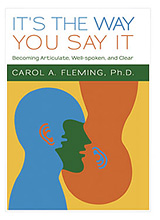
Carol Fleming, Ph.D., is the author of “It’s the Way You Say It”! Becoming Articulate, Well-spoken and Clear. A comprehensive guide to vocal development and improvement of communication skills. For people who want to make their speaking more impressive and find their voice. She can be contacted at telephone 415.391.9179 or send her an email at [email protected]

How can a book improve your communication? There are two ways, you can read it or you can put it on your head.
Explanation:
Actually there is only one book to read that will really be helpful for the wide array of communication needs of the modern world and that book is the one I wrote; It’s the Way You Say It: Becoming Articulate, Well-spoken and Clear. See below.
The book you put on your head needs to be hard cover – (Mine comes in hard cover!) - so it can balance on your head. Now, why on earth would you want to do such a thing?
Because it will act as a feed back mechanism about the way you hold your body, your posture. Your carriage will have a marked influence in how you are perceived.
- You cannot be dignified if your head is bobbing up and down, nodding or tilting.
- You cannot look mature if you tend to cock your head to one side.
- You cannot look ‘together’ if you bounce along as you walk or allow your shoulders to slouch forward and pull your head out of alignment.
Everybody admires strong, upright posture.
This is where the book comes in as an excellent source of information.
1. As you look in the full length mirror, hold yourself in an up-right (but natural) posture and place the book flat on the top of your head.
2. Try turning your head from side to side, keeping your chin line straight. Take some steps forward and back and from side to side, keeping that book in place.
3. Walk around the room, keeping that book in place on your head.
4. Now add the speech component; start talking and notice how much you want to move your head.
5. Sit on front of a mirror and call someone on the phone. Place the book on your head and start talking. You will probably lose the book a couple of times.
6. At all times, pay attention to the alignment of your head and body as you use the book, so you can learn how to hold your head and body upright without the book.
7. Give yourself daily practice with this routine for a week and you should be able to ‘straighten up’ with only conscious effort (and no book).
Announcement: Dr. Fleming’s book can now be purchased at Alexander Book Co and Book Passage in both Corte Madera and San Francisco!
If you want to learn more about how Dr. Fleming can help you improve your communication skills, please call her at telephone 415.391.9179 or send her an email at [email protected]
Carol Fleming, Ph.D., is the author of “It’s the Way You Say It”! Becoming Articulate, Well-spoken and Clear. A comprehensive guide to vocal development and improvement of communication skills. . To get your own copy, go to http://amzn.to/ItsTheWayYouSayIt
I spoke at The Commonwealth Club last week. Here is one of the emails I received:
“Monday night’s speech was terrific!
I just finished an important Company presentation (online & phone) with 6 key players on a very important subject. I attached 2 small sticky notes with tips from your speech to the bottom of my PC monitor. One said “speak slow & deliberate”. The other said “pause“.
I got several nice compliments at the end from the participants. Thanks Dr. Fleming!”
Now why do you suppose I really like this message? You would think it was the “terrific” comment, wouldn’t you? Has he just confirmed worthiness on me and with what authenticity? Actually such expressions are formulaic and do not tell you exactly what was valued. Indeed, it could be just a feel-good dismissal, there could be sarcasm involved, and you really don’t know anything about your effectiveness.
BUT, look carefully at the rest of his message:
- He showed me that he took in some specific information from the talk and that I was making a difference in the way I want to.
- He told me what he did consequent to my talk (took the time to make notes and stuck a few to his monitor), that my speaking led to an action.
- He used those particular hints to pace his presentation. His specificity increased the authenticity of the compliment.
- He told me that he received compliments as a result of the hints; my speaking made a difference to him.
This is all without the distortion of hyperbole but with the ring of sincerity. What more do you want? Thank you, Richard.
You can see more examples of the sensitive use of language to transform relationships in my book, It’s the Way You Say It: Becoming Articulate, Well-spoken and Clear, p.102.
To learn more about how Dr. Fleming can help you improve your communication skills, please call her at telephone 415.391.9179 or send her an email at [email protected]
Carol Fleming, Ph.D., is the author of “It’s the Way You Say It: Becoming Articulate, Well-spoken and Clear”. A comprehensive guide to vocal development and improvement of communication skills. . To get your own copy, go to http://amzn.to/ItsTheWayYouSayIt
We have all had the experience of seeing a really good looking person standing there silently: so handsome, so stylish, so sexy. We have a chance to imagine them with an equally attractive personality.
And then they open their mouth and say something.
Oh dear, the image is shattered. The voice is harsh, the pitch high, the rate fast and the content vapid. NOT what you expected from the gorgeous one. Feel that disconnect? The let-down?
Let’s turn thus around and apply it to you.
How much time do you spend on your appearance before leaving your home? Male or female, boy or girl, you are plucking, combing, cleaning and preening to make yourself attractive as possible.
Think: (1) how important it is to you that you are dressed appropriately for the occasion; and (2) how much time do you spend in front of the mirror.
Now, how much time do you spend considering the sound of your voice, hmmm?
Don’t bother, I already know the answer.
3 Tips you really should consider to improve “The Sound of Your Voice”
1. Your personal credibility is strongly related to the congruity of the sound of your voice and your visual image. It determines the authenticity of your first impression. Does your voice say the same thing that your visual image does?
2. If you will actually listen to yourself talk on a decent recording you will learn more about yourself than any psychologist can tell you. And once you know how you really sound, you can determine if there is something about the way you talk that you would like to change. Or not. Many people find that they are a lot better than they thought they were, once they actually listen to themselves.
3. You can change many features of your personal communication if you want to; voice quality and pitch, speaking rate, vocabulary, mannerisms, courtesy, vocal quality or volume. It will probably not be quick or easy, but it might be the most important investment in your personal development that you could make. You will need to find the appropriate coach to help you but it is your determination that will make it happen.
It is natural to care about the impression you make by the way your look …and sound. Let’s see if you can’t get them to say the same thing.
If you want to learn more about how Dr. Fleming can help you improve your communication skills, please call her at telephone 415.391.9179 or send her an email at [email protected]
Carol Fleming, Ph.D., is the author of “It’s the Way You Say It”: Becoming Articulate, Well-spoken and Clear. A comprehensive guide to vocal development and improvement of communication skills. To get your own copy of my new book, please go to:
http://amzn.to/ItsTheWayYouSayIt
I once had a speech client who admitted that he was a social isolate. This was revealed at the same time that he confessed that he never got the job advancement (despite having a Ph.D. from a prestigious university), was never included socially and certainly never got a girl. He spent much time telling me how others ignored him (and probably plotted against him!).
What was finally revealed was that:
- He made absolutely no effort to talk to anybody himself.
- He lived in his own bubble of silence.
- He did not understand that this very behavior was a big ‘Go away’ to other people and that he would be perceived as rude.
- He did not know that it was in his power and in his best self-interest to create the possibility of relationship with others.
His first homework assignment: to offer a ‘hello’ to someone every day. You laugh. But you must start somewhere. He was to actually make eye-contact with someone on the elevator and offer some verbal greeting, just one human being acknowledging another.
You would think I had asked him to have open-heart surgery. Well, I guess, in a way, I did.
How about you? How much of an effort do you make to connect in real time with real face-to-face people? And I am talking about everybody from the custodian to the CEO of your organization. Much good comes from being recognized as an amiable person.
Of course, you know that it is nice to talk to everybody. I’m not talking about ‘nice’ today; I’m talking bout self-interest.
- It is in your self-interest to be polite.
- To be polite is to offer people both warmth and respect. At the same time.
- You must acknowledge the other person through your eyes and voice, recognizing their existence but not intruding into their mental and physical space. You do not go for a handshake but you do say, “hello”. We’re talking baby steps here.
- As Steinbeck said, “Be the inferior of no man, nor of any man be the superior. Remember that every man is a variation of yourself.”
The respect you offer to others will be returned to you.
……………………………..
If you want to learn more about how Dr. Fleming can help you improve your communication skills, please call her at telephone 415.391.9179 or send her an email at [email protected]
Carol Fleming, Ph.D., is the author of “It’s the Way You Say It”! Becoming Articulate, Well-spoken and Clear. A comprehensive guide to vocal development and improvement of communication skills.